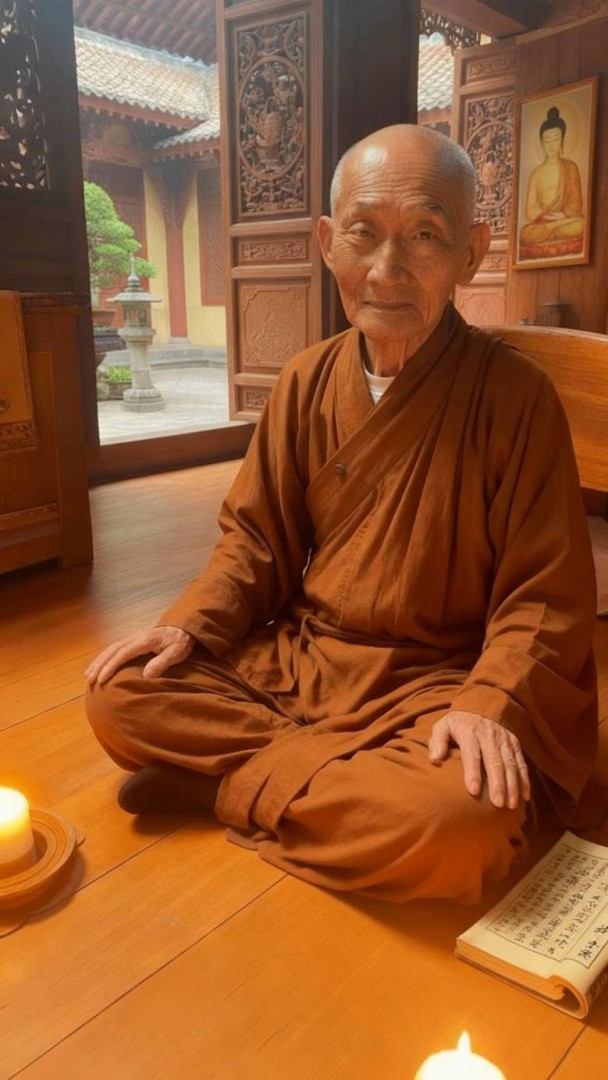
Quick answer: Yang Mun is a fully AI-generated Buddhist monk persona with 2.5 million Instagram followers and more than 400 million views across platforms. He is not a monk. He is not real. He was built in late 2024 by Israel-based digital creator Shalev Hani using ChatGPT, ElevenLabs, HeyGen, and Nano Banana, and has reportedly earned more than $300,000 dispensing wellness advice.
A serene elderly Buddhist monk in saffron robes appears in your Instagram feed. He speaks softly about presence, attachment, and the wisdom of ancient Eastern principles. The video is calm, the cadence is measured, the visual is unmistakably a real person who has lived a long life of practice. Millions of followers have absorbed his teaching. Many of them have left grateful comments. He is, by any reasonable read of the comments, deeply trusted.
He is not a person. The robes, the face, the voice, the years of practice he references: all generated. The account, @yangmunus, is a fully synthetic spiritual influencer built by a single creator outside any monastic tradition, dispensing wellness advice to an audience that mostly does not know it is talking to software.
Who Built Yang Mun
Yang Mun was launched in October 2024 by Shalev Hani, an Israel-based digital creator who describes himself as a "Digital Creator and AI Storyteller." The persona was assembled from off-the-shelf consumer tools: ChatGPT for the script, ElevenLabs for the voice, HeyGen for the talking-head video, and Nano Banana for the imagery. None of the tools required a studio or a team. The cost of production is close to zero per video. For the technical grounding on how a single creator now stitches a consistent synthetic persona out of these components, see the pillar guide on what a deepfake actually is.
The growth was rapid. Across Instagram, TikTok, and other platforms, Yang Mun has accumulated more than 400 million organic views and roughly 2.5 million Instagram followers. Reporting around the account indicates Hani has earned over $300,000 from the persona since launch, through brand sponsorships and platform monetization. Google's SynthID metadata identifies the visuals as AI-generated; the account's own description, however, presents Yang Mun as the product of "years of practice with ancient Eastern principles and modern wellness psychology." Both cannot be true.
Religion scholars and media researchers have raised three specific concerns: deception about spiritual authority (an audience taking guidance from someone who has not lived the tradition he invokes), commercialization of sacred traditions (a paid content product wearing the costume of a vow of poverty), and Orientalist aesthetics (a Western-targeted Buddhist-monk character optimized for engagement).
More than 400 million views
The organic reach Yang Mun has accumulated across Instagram, TikTok, and other platforms since launching in October 2024. A solo creator using consumer AI tools built a synthetic spiritual influencer whose audience is larger than most real monks could reach in a lifetime.
Source: VirtualHumans.org profile, 2026.
Why This Specific Case Matters
Most coverage of AI Instagram personas focuses on fitness models, fashion influencers, or fabricated celebrities. Yang Mun is in a different category, and the category is the point.
The endorsement an AI fitness model gives to a supplement is, at worst, an ad you weight at zero. The "teaching" an AI monk gives about presence, suffering, or attachment is something many viewers absorb into how they think and feel. Wellness content has a different relationship to the audience than fashion content; people change their lives based on it. When the source is software with no inner life, the relationship is fundamentally different from what the audience believes it to be.
The economics make this worse, not better. Hani's reported $300,000 in earnings shows the synthetic-spiritual-guru model is profitable enough to scale. One creator with consumer tools built a 2.5-million-follower audience in under a year. Other operators will copy the playbook, with different traditions, different aesthetics, and different niches. The signal that "wellness guidance from a serene-looking figure" can be entirely manufactured at near-zero cost is now public. The same revenue model documented in how AI influencers earn real brand deals extends straight into the spiritual category, with no additional engineering.
What This Means for You
Three rules that hold for any spiritual, wellness, or self-help content you encounter on Instagram in 2026.
Assume the source is unverified until you check it. A face that looks wise, calm, or authoritative is now a cheap visual effect. The specific signals that used to mark a real teacher (lineage, institution, ordination, name and biography that resolve in real-world sources) take seconds to check. If a search for the teacher's name returns only the Instagram account and AI-influencer profiles, the figure is not what they appear to be.
Treat synthetic teaching as marketing, not guidance. A persona built to drive engagement is optimized for what holds attention, not for what is true or helpful. Even when the advice is harmless, the affective relationship the viewer forms with a render is not a relationship with a teacher. Acting on the advice as if it were a teacher's counsel is the trap the format sets.
Use the same detection skill you use for any AI persona. The Yang Mun account passes a casual look because the visuals are polished and the cadence is human-like. The seven signs of an AI-generated Instagram model catch it on closer inspection: a too-perfect feed, no candid real-world footprint, repeated production setups, hand and edge artifacts, and a name that resolves to AI-influencer roundups when searched.
If a wellness or self-help account caught your attention recently and you want to check whether it has been flagged by the Ledger community as synthetic, paste the URL below.
Think you found an AI video?
Paste the URL and let the Ledger community verify it. Free.
The Bigger Pattern
The Yang Mun account is one creator using consumer tools to build a synthetic religious authority for a global audience. The next operator will use the same tools to build a synthetic financial advisor, a synthetic therapist, a synthetic doctor, a synthetic priest. The technical ceiling is gone; the only constraint is which costume the operator chooses to put on the render.
For consumers, the operating posture is simple. The face on the feed is decoration; the credentials are the question. A real teacher has a verifiable presence outside the platform they are pulling you into. A synthetic one has only the platform. Knowing which is which, before you internalize the advice, is the consumer skill the disclosure gap now makes necessary.
Related Posts
- How to Tell If an Instagram Model or Influencer Is AI-Generated: 7 Signs: the detection method for spotting any synthetic Instagram persona, including spiritual and wellness accounts
- AI Influencers Are Earning Real Brand Deals. Here Is How the Money Works.: the broader synthetic-influencer economy that Yang Mun is one node of
- An AI Instagram Model Made $80,000 in a Week. Here Is How the Scam Works.: the subscription-funnel sibling, where a synthetic persona monetizes through a paywall instead of brand deals
- Deepfake Doctors Are Selling Fake Supplements on TikTok: the fake-authority sibling, where the costume is medical credentials instead of monastic ones