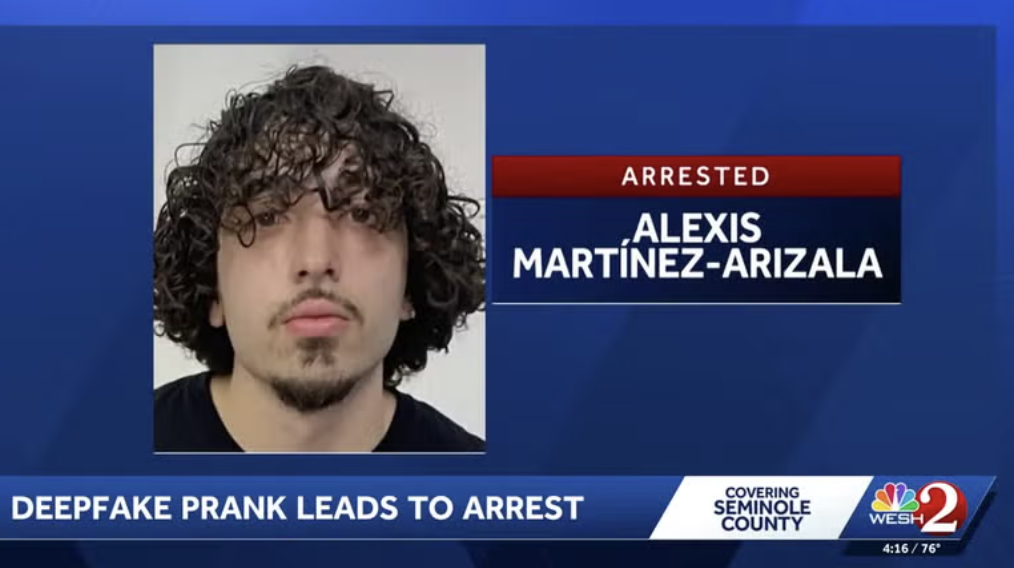
Quick answer: In April 2026, Florida prosecutors charged 22-year-old Alexis Martínez-Arizala with fabricating a 3-second AI deepfake video of a patrol-car break-in to trick a Seminole County deputy. The deputy responded as if it were real. Investigators tied Martínez-Arizala to earlier deepfake provocations at a Home Depot in West Palm Beach. He was arrested in Puerto Rico.
A Seminole County, Florida deputy was inside an Academy Sports store on Lake Emma Road in Lake Mary in March 2026 when a stranger approached him and held up a phone. The video on the screen was three seconds long. It showed people breaking into the deputy's marked patrol car in the parking lot.
The deputy responded immediately. He exited the store with his hand on his weapon and approached the patrol car.
Nobody had touched it. The video was AI-generated. The man who showed it to the deputy, 22-year-old Alexis Martínez-Arizala, was filming the deputy's reaction. According to local reporting, he was capturing the moment for social media.
A warrant was issued. Deputies located Martínez-Arizala in San Juan, Puerto Rico, and he was extradited and booked on a $7,000 bond. Click Orlando reports the charges as fabricating physical evidence, making a false report to law enforcement, unlawful use of a two-way communication device, and knowingly giving false information to a law enforcement officer concerning the alleged commission of a crime.
What Happened, According to the Sheriff's Office
Fox 35 Orlando and Click Orlando reported the case in early April 2026. Store surveillance footage proved that the parking lot was undisturbed during the timeframe Martínez-Arizala had claimed. The video on his phone was the only evidence of a break-in, and it had been fabricated.
Seminole County Sheriff Dennis Lemma's stated concern was direct: "These fabricated videos can damage reputations, create unnecessary tensions." His department escalated the case once they realized the deputy's reaction was being staged for content.
The most important thing to notice in this case is what the deputy did right and what the system caught. The deputy treated the video as credible evidence, which was reasonable in the moment. The catch came afterwards, when surveillance footage contradicted what the AI video claimed.
This Was Not a One-Off
A follow-up Click Orlando report on April 10 tied Martínez-Arizala to a series of similar incidents in West Palm Beach. The pattern was the same in each one: approach a stranger or an officer in public, present an AI-generated video on a phone showing a crime in progress, demand that they respond, and film their reaction.
A shopper named Melanie Valentine described being approached at a Home Depot in West Palm Beach in an earlier incident. The man showed her an AI-generated video that appeared to show her husband's truck being stolen from the parking lot. He insisted she follow him outside to "catch" the thief. The truck was parked exactly where she had left it. "It was very real," she told Click Orlando.
Police reports from the same Home Depot list other AI-generated provocation videos, including one of a man being dragged at a gas station. Captain Roy Bevell of West Palm Beach police described one of the staged scenarios this way: "He approached the man and said, 'Hey, here's a video of your wife outside with another person.'"
That detail matters. The pattern is not specifically about pranking police. It is about using AI-generated video as a weapon to provoke real reactions from real people, then capturing those reactions as content.
3 seconds
the length of the AI deepfake video that made a Seminole County deputy approach his patrol car with a hand on his weapon in Lake Mary, Florida, in March 2026.
Source: Click Orlando, April 8, 2026.
Why This Is a Different Kind of Deepfake Threat
Most deepfake fraud you read about is asynchronous. A scam video circulates on TikTok or Instagram, you see it on your feed, and you decide whether to engage with it. There is space between the content and your reaction. You can pause, search, ask someone, or scroll past.
The Martínez-Arizala pattern collapses that space. The video is shown to you in person, by a stranger, with urgency framing. You are expected to act on it within seconds. The deputy who reached for his weapon was not failing at video literacy. He was responding to what looked like an active crime, presented as a live video by a person who acted as if they had just witnessed it.
This is the same trust signal that a security camera or a body cam carries: video, especially short clips that look like raw phone footage, has historically been treated as evidence of what happened. AI generation tools have removed the floor under that assumption. A three-second clip that would have required studio resources two years ago can now be produced in minutes from a single still photo or no source material at all.
The danger here is less about who is filming and more about what people do when they believe they have seen video evidence of a crime in progress. Drawn weapons. Confrontations with the wrong person. Calls to 911 that send armed officers to an address that has done nothing wrong. The deputy in Lake Mary did not fire his weapon. The next deputy might.
What to Do If Someone Shows You a Video Demanding Action
The detection skill that matters here is different from the one for catching AI on TikTok. You will not have time to scrub frame by frame. You will have a person in front of you insisting that something is wrong and that you need to act.
Trust the surroundings before the video. If the video claims something is happening twenty feet away, look at the actual location before you look at the screen. The parking lot, the storefront, the street. A real event leaves real evidence in the physical world. A fabricated event does not.
Refuse to act on a stranger's video. No legitimate crime report depends on a stranger's phone. Real witnesses typically call 911 from the scene. If someone is pressing a video at you and demanding immediate action, the request itself is the tell.
Ask for the source and the timestamp. A real video has a place in a phone's camera roll, with a date and time and GPS metadata. Ask to see the camera roll. Ask when the clip was taken. A real witness will show you. A fabricator will resist or stall.
Stay until law enforcement arrives. If the video is real, the witness will want to give a statement. If it was generated, they will leave fast or refuse to engage. Provocateurs need the reaction, not the resolution.
The general detection skill set, including the seven signs of an AI-generated video and the six visual tells of an AI face, still applies once you have the time to look. In the moment, the fastest defense is the behavioral one. A stranger pressing a phone at you is the situation, not the video.
What to Do If You Were Targeted
If you were a target of an in-person AI-deepfake provocation, document everything you can: the person, the location, the time, the device shown, anything they said about themselves or where the video came from. File a police report. The behavior fits established crimes: false report, fabricating evidence, fraud, harassment. The Martínez-Arizala case shows prosecutors are willing to charge it as such.
If you encounter an AI video on a platform after the fact, the standard reporting flow applies: capture, report, and move on. The full sequence is in what to do after you find a deepfake. For situations where the deepfake targets a specific person and circulates as harassment, the legal pathway has tightened, including federal options under the TAKE IT DOWN Act.
If you want to check whether a specific TikTok or social-media video has already been flagged by the Ledger community, paste the URL below.
Think you found an AI video?
Paste the URL and let the Ledger community verify it. Free.
The Bigger Pattern
What makes this case worth reading is the threat shape, not the prank. The same tools that produce celebrity-endorsement scams on TikTok can now produce a three-second clip of your husband's truck being stolen, designed for one viewer in a parking lot. The rule that catches every variant: when a video creates pressure to act before you can verify, the pressure is the message. Real evidence does not require you to react in the next ten seconds.
Related Posts
- What Is a Deepfake? A Plain-English Guide for Social Media Users: the underlying technology that makes a 3-second clip credible enough to provoke a police response
- The 6 Visual Tells That Instantly Give Away an AI Face on Video: the signals that work once you have time to slow down and look
- What to Do When You Find a Deepfake on TikTok, Instagram, or Facebook: documentation and reporting flow once the moment has passed
- Is It Illegal to Make a Deepfake? What the Law Actually Says in 2026: the criminal exposure for using AI video to fabricate evidence or false reports