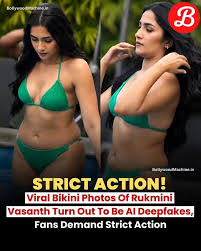
Quick answer: Indian actress Rukmini Vasanth announced legal action on May 23, 2026 over AI-generated bikini images circulating as if leaked from a film shoot. The detail that made the fake convincing was the staged production-set background (cameras, lights, crew) added to suggest real on-set footage. The verification flow that catches the upgrade is the same one that catches the simpler version.
On May 23, 2026, Indian actress Rukmini Vasanth posted statements on Instagram and X addressing AI-generated bikini images of her circulating across South Asian social media. Her statement: "My team and I have come across certain AI-generated images being circulated online claiming to be me. I want to state clearly that these images are entirely fake and fabricated." She characterized the creation and circulation of the content as "deeply irresponsible and a serious violation of privacy" and announced that her team was pursuing legal and cybercrime action.
The detail that made the Rukmini Vasanth deepfake spread further and faster than a basic celebrity face-swap was the background. The synthetic images were composed to look like behind-the-scenes leaked footage from a film shoot: cameras visible at the edge of the frame, lighting rigs, what appeared to be crew positioning. The composition did not just synthesize the actress. It synthesized the production context that would make the content plausible as a real on-set leak.
This post walks through why the fake-production-set background is the upgrade that most defeats casual verification, what specific cues distinguish a real on-set leak from a generated one, and the same verify-before-believing principle Giorgia Meloni invoked earlier this month.
For the broader technical grounding on how AI image and video synthesis composes scenes (not just faces), see the pillar guide on what a deepfake actually is.
The Mandanna precedent
Rukmini Vasanth's case is the most-recent in a documented pattern affecting Indian actresses including Rashmika Mandanna (November 2023), Alia Bhatt, and Katrina Kaif. The Mandanna case prompted India's first government statement framing deepfakes as a violation requiring legal response, and contributed to the 2024 IT Rules amendments addressing synthetic media. The Vasanth case extends that pattern with the production-set composition trick.
Source: Social News XYZ coverage of Vasanth statement; India TV News coverage of Vasanth legal action.
Why the Fake Production Set Worked
A bare celebrity deepfake, a face composited onto a stock body in an empty setting, is the version that has been around for two years and that casual viewers have learned to suspect. The Vasanth deepfake is the next iteration. The synthetic image carried its own justification for why the viewer was seeing it: this is a behind-the-scenes leak from a shoot. The presence of cameras and lights at the edges of the frame did three things at once.
It reframed the suspension of disbelief. A viewer scrolling past a bare bikini image of an actress is primed to question whether the image is real. A viewer scrolling past a film-set image of an actress between takes does not start from "is this real" but from "I am seeing something inadvertently disclosed." The cognitive frame shifts from skepticism toward assumed authenticity.
It supplied a fake provenance story. The presence of production equipment implied a chain of custody (someone on the crew leaked it from a phone, the file got out of an editing room) that did not require external verification. A viewer who would have asked "where did this come from" sees an answer inside the image.
It exploited the routine existence of on-set production environments around any working actress. A purported leaked on-set image maps onto a category of content viewers know exists, without requiring the viewer to verify it against any specific named production. The deepfake did not have to invent the scenario; it just had to attach the actress to a category of content viewers already accept as routine.
This is the same diffusion pattern documented in our Iran airman incident coverage: synthetic content spreads not because every viewer believes it but because enough viewers find it plausible enough to share without checking. The production-set background is what raises the share-without-checking threshold.
What the Image Actually Lacks (and How You Can Tell)
A real on-set leak carries operational details a synthesized image cannot include without naming them. Four categories of detail that the synthetic version misses.
The production company watermark or slate. Real on-set footage carries metadata: a digital slate visible somewhere in the frame, a production-company logo on equipment, a clapperboard, a call sheet on a folding chair. Synthesized set backgrounds produce generic camera and light shapes but cannot include the specific markers that link the image to a named production. If the purported leaked set image does not identify which film it is from, the absence is the tell.
Crew faces and continuity. A real on-set image, even one cropped tight, almost always has a crew member's hand, shoulder, headset, or back visible at the edge. The crew is the largest body of people on a set. A purported leaked set image with the actress alone in an otherwise-empty production environment is internally inconsistent. Real sets are not empty.
Lighting that matches the equipment in frame. Real production lighting comes from the rigs visible in the image. If the visible rigs are off, dim, or pointed wrong relative to where the light on the subject is actually coming from, the lighting was rendered separately from the equipment. The directionality of light on the actress should be physically traceable to the rigs that are in the frame. Synthesized scenes typically fail this check.
A production this content would belong to. A real on-set leak comes from a film that exists. A reverse image search or a check against the actress's announced filmography on IMDb or her official social accounts produces either a match (the production is real, the leak might be real, the legal situation is what it is) or a non-match (no announced film matches this setting, no production company has confirmed shooting this scene). The non-match is the strongest single non-image signal.
The same pattern that applies to identifying a deepfake of a doctor in a TikTok ad applies here: real professionals have a public trail (license number, hospital affiliation, named employer). Real actresses have a public filmography. The synthetic version cannot generate the documentary record that the real version is embedded in.
Think you found an AI video?
Paste the URL and let the Ledger community verify it. Free.
The Verify-Before-Believing Flow, Applied
The principle Meloni invoked earlier this month works the same way here. The translation is concrete.
Check the actress's official accounts. If the actress has not posted, referenced, or commented on the "leaked image" within 24 hours of it going viral, the silence is informative. Vasanth's response landed on May 23 with a direct denial and announcement of legal action. The verification step is reading the denial, not reading the image.
Reverse-search the background, not just the face. Reverse image search tools (Google Images, TinEye, Yandex) often catch the production-set background more cleanly than the face. Synthesized backgrounds frequently borrow elements from stock images of film sets that exist in image-search corpora. The match is the tell.
Run a 30-second flow that does not start with the face. Look at the equipment first. Look at the crew presence (or absence). Look at the lighting physics. The face is where the visual quality of the synthesis is highest and where the synthesis is most likely to defeat your eye. The production context is where the synthesis is weaker.
If you want a structured walkthrough of the underlying detection signal set rather than the production-set-specific tells above, the pre-share 5-minute verification protocol covers the broader workflow.
What This Case Adds to the Pattern
Two extensions of what the Mandanna (2023), Bhatt, and Kaif cases established. First, the synthesis is composing scenes, not just faces. The Mandanna case was a face-swap onto an existing video; the Vasanth case is full scene synthesis with deliberate composition choices to manufacture provenance. Second, the platforms have not closed the upstream gap. The image circulated through Indian social platforms before, during, and after Vasanth's denial. The same pattern driving Meta's labels-over-removal posture and the EU AI Act Article 50 transparency rules is what played out on the Indian platform stack: labels lag synthesis, removal lags labeling, and viewer-side verification remains the floor.
What This Means for You
Vasanth's case is useful to readers outside India because the production-set technique is generalizable. The same composition logic will appear in cases targeting people who are not actresses (a purported leaked workplace photo of a colleague, a purported leaked security-camera image of a neighbor, a purported leaked classroom photo of a teacher). The trick is to add the context that justifies why the viewer is seeing the content. The verification flow is the same: check the named entity directly, check the production or workplace context independently, do not let the apparent provenance inside the image substitute for actual verification.
If a deepfake image or video of someone you know caught your attention recently and you want to check whether the account behind it has been flagged by the Ledger community, paste the URL below.