Quick answer: A viral Twitter image showed a man face-swapping into an "AI girl" persona for OnlyFans and Fanvue. The image proves the method, not the revenue claims. The AI Journal documented one anonymous operator earning ~$20,500 over 90 days on a four-tool stack costing about $77 per month. Real performer plus AI face: a hybrid, not a render.
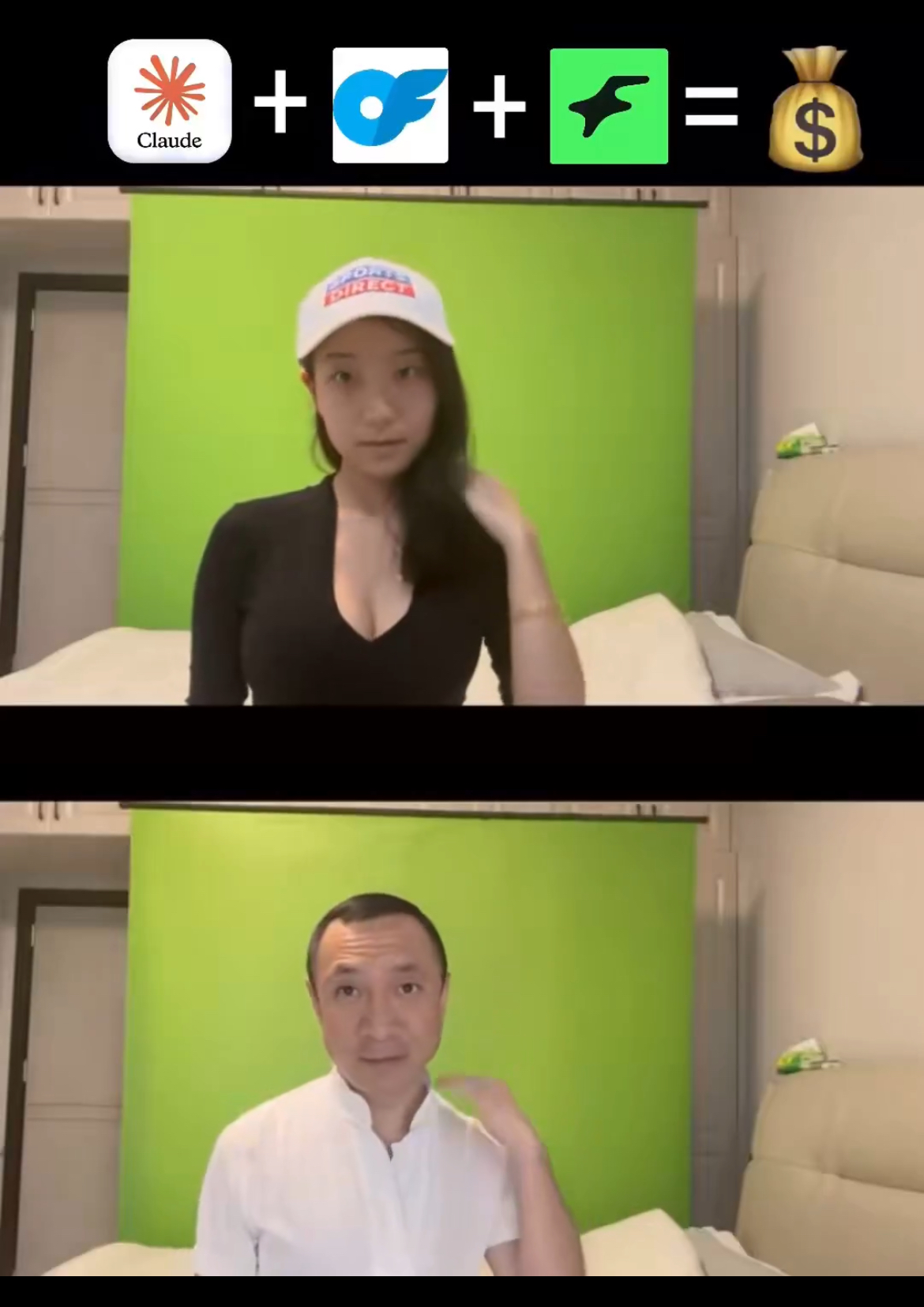
A side-by-side image went viral on Twitter recently. On the top half: a young Asian woman in a Sports Direct cap in front of a green screen, the "AI girl" running an OnlyFans and Fanvue account. On the bottom half: a middle-aged Asian man in a white shirt, in the same room, same chair, same green screen, posed identically. The header bar labels the stack: Claude plus OnlyFans plus a talking-head video tool.
The image is the same recording with a face-swap on the top frame and the original face on the bottom. The "AI girl" is not generated; she is a face-swap performance by the operator on the bottom. The Twitter post around the image claims the operator earned $13,450 in a month, ran traffic through TikTok and Reddit, and used Claude to autonomously run everything. Those specific figures cannot be independently verified, and the originating thread has the texture of a content-marketing pitch (it ends with a download of "10 folders of tools," common for paid-template promoters).
What is verifiable is the method, and the method is the story.
What the Image Actually Proves
The image is operator-self-published proof of one specific thing: that the "AI girl" account is run by a real person whose face is replaced in the published content by a face-swap. The identical pose, identical room, identical lighting, and identical posture in both halves rule out the alternative explanations (different recording, different person). It is the same recording with two different faces.
That is meaningfully different from how the public usually pictures an "AI influencer." Posts on Aitana López, Yang Mun the AI Buddhist monk, or the synthetic personas covered in the AI-influencer-economy explainer describe rendered characters: the body, the room, the voice, all generated. The operator stack in the viral image is a different shape. A real human performs the body language, the voice, the camera presence. The AI replaces only the face. The "girl" is a digital mask, not a render.
This matters because the hybrid pattern is much cheaper to run and much harder to detect than a fully synthetic persona. The performer supplies what AI still struggles with (natural micro-expressions, lived-in pose, voice quality, off-script reactions). The face-swap supplies what the performer cannot (a different, marketable, consistent appearance).
The Documented Case Behind the Pattern
The Twitter image is one viral artifact; the playbook behind it is documented in detail elsewhere. A March 2026 feature in The AI Journal profiled an anonymous operator who built an AI-influencer pipeline and reported the exact tooling and revenue numbers.
That operator's reported results:
- Day 30: about $3,500 per month on OnlyFans
- Day 60: about $12,500 per month on Passes (they switched platforms mid-experiment)
- 90-day total income: roughly $20,500
- Instagram audience at Day 30: 50,000 followers, fed by 2-3 posts per day plus daily stories plus 3-5 TikTok videos per week
The tool stack:
- Higgsfield for short-form video and character creation, about $17 per month
- Gemini for image generation, $20 per month
- ChatGPT for caption writing, $20 per month
- Claude for content strategy, $20 per month
- Roughly $77 per month total
That cost number is the headline. A solo operator with consumer subscriptions can run an end-to-end persona-content pipeline for less than the cost of a phone plan. The operator described in the AI Journal feature explicitly chose anonymity; the figures are their self-report, not independently audited.
~$77 per month
The total tool-stack cost reported by the AI Journal case operator for an end-to-end AI-influencer pipeline: Higgsfield plus Gemini plus ChatGPT plus Claude. The same operator reports about $20,500 over 90 days. The revenue is self-reported and unaudited; the tool cost is the verifiable part.
Source: The AI Journal, March 2026, anonymous operator interview.
Why the Hybrid Defeats Two Different Defenses
The fully-synthetic-persona detection method, covered in how to tell if an Instagram model is AI-generated, looks for signals that a rendered character is producing the content: too-perfect feed, repeated backgrounds, no real-world footprint, hand and jewelry artifacts. Those signals catch fully synthetic personas. They miss face-swap hybrids because most of the production is real. The room is real. The body is real. The voice is real. The camera presence is real. Only the face is swapped.
The video-deepfake detection method, covered in how to tell if someone on a video call is a deepfake, works on the face-swap layer specifically. Hand crossing the face, sharp profile turn, sudden lighting change all expose the swap. Those checks work on a live video call. They are much harder to run on a pre-recorded TikTok or Fanvue post because the operator records the clips that hide the swap's weaknesses and discards anything that exposes it. Pre-recorded content is the operator's edit; live video is yours.
The hybrid sits in the seam between the two detection methods, which is exactly the seam it was built to exploit.
What This Means for You
Three rules that hold whether the persona is fully synthetic or a face-swap hybrid.
Treat any subscription account that funnels from social media as a render until proven otherwise. A polished social-media account whose bio link goes straight to OnlyFans, Fanvue, or any subscription platform is the monetization endpoint the entire production exists to feed. The full subscription-funnel mechanics are documented in how an AI Instagram model made $80,000 in a week. Whether the persona is rendered or face-swapped, your subscription dollar is paying a production operation, not a creator.
The "live video call" verification still works on the hybrid. The face-swap layer breaks under physical tests the operator cannot edit out in real time. If you are interacting with the persona one-on-one and want to verify, request a live video and run the gesture tests from the video-call detection guide. The pre-recorded posts are the operator's edit; the live interaction is yours.
Recognize what is being taken from real creators. Face-swap pipelines also harvest the faces of real OnlyFans and Fanvue creators, which then appear on operator-run accounts without consent. Fortune reported in 2024 that this pattern is costing real creators significant revenue and is poorly policed by the platforms. The synthetic-persona stack and the face-theft stack share the same tools; many of the "AI girls" on subscription sites are face-swapped real people who did not consent.
If a TikTok or Instagram account caught your attention recently and you want to check whether it has been flagged by the Ledger community, paste the URL below.
Think you found an AI video?
Paste the URL and let the Ledger community verify it. Free.
The Bigger Pattern
The same hybrid pattern showed up in scam-compound video calls, where real workers are face-swapped in real time to match the persona a victim expects. That is the deception side of the pattern: human plus AI face used to defraud one person at a time. The creator-economy version visible in the viral Twitter image is the monetization side: human plus AI face used to monetize subscriptions from many viewers at a time. Same components, different deployments. The technical foundation under both is covered in the pillar guide on what a deepfake actually is: the face-swap layer is the same generative-model output regardless of whether it sits on top of a scam-compound worker or a creator-economy operator.
The defense framing follows. Detection assumed for a long time that the choice was between "real human" and "fully synthetic AI." The hybrid is the third category, and it is the fastest-growing one because it inherits the AI's economic advantages (low cost, controlled appearance, infinite production) while keeping the human's hard-to-fake authenticity (real body, real room, real voice). Knowing the category exists is the first step in not paying it the trust it borrows.
Related Posts
- An AI Instagram Model Made $80,000 in a Week. Here Is How the Scam Works.: the subscription-funnel sibling on the highest-grossing documented operator case
- AI Influencers Are Earning Real Brand Deals. Here Is How the Money Works.: the broader synthetic-influencer economy, the fully-rendered cousin of the hybrid covered here
- Scam Compounds Are Hiring Real People to Deepfake on Video Calls. Here Is How the Hybrid Works.: the deception-side version of the same human-plus-AI-face hybrid pattern
- How to Tell If Someone on a Video Call Is a Deepfake: 7 Real-Time Tests: the live-call test sequence that exposes a face-swap layer the way pre-recorded edits cannot